Friday, November 25, 2016

Boat Parts and Accessories Experts Keep You Safe From Sailing Risks


Copyright Clipper Around the World Race


Your Boat Parts And Accessories Specialists Say That Boating Really Can Be a Physical Sport


Stainless Marine your boat parts and accessories professionals would like to share with you these topics we thought would be of interest to you this month regarding how to stay safe from sailing risks.


Your boat parts and accessories analysts know that most conclude that football is a contact sport and sailing takes the other tack. But after the amateur crew aboard the 75-foot ocean racer IchorCoal suffered its second fatality in six months, many have suggested that it's time to take a closer look at just what went wrong and what's really at stake in pay-to-play big boat ocean racing.


During the very first leg of the current 2015-16 Clipper Race, disaster struck when 49-year-old Andrew Ashman was hit in the head by the mainsheet tackle, knocked unconscious, and died shortly thereafter. 


This adventure sail event was concieved by Sir Robin Knox-Johnston in 1995, and over the next two decades the race has been run under the auspices of Clipper Ventures with William Ward and Jeremy Knight joining Knox-Johnston as directors.  


Over the years, the Clipper fleet has become more performance capable, and with greater speed and an increased sail-area-to-displacement ratio comes additional challenges.


If you were fainthearted, you probably wouldn´t even get this far on an Atlantic crossing site, let alone plan on a large ocean voyage in a small boat. 


On an Atlantic voyage there are some serious threats. Most can be prepared for; although some will be up to Gods will only.


Boom injuries

There are many stories of poor sailors, alive at one second and dead in the next, killed by an unexpected swing of the boom. A sudden change in the wind, a freak wave, a mistake in the setting of sails or an autopilot error – all could cause the boom to violently swivel over the cockpit in an instant.


At long, monotonous ocean voyages it is good to use a preventor, rigged from the boom end to the bow of the boat. It will keep the boom from unexpected movements. 


Tsunamis

One friend had a large freak wave, probably caused by an underwater volcano eruption. It hit the boat at night, in perfectly calm seas. 


Man over board

This is a terror as finding somebody in the large waves of the Atlantic, when the boat speeds at 7 knots – perhaps at night – is if not entirely impossible, then almost near impossible.


Another good thing is the fluorescent stick commonly used for scuba diving in case of emergency. You keep it in your life-west and brake it in the water. 


Go to http://www.stainlessmarine.com/about-us/ and see how you can find more information as well as get assistance on boat parts and accessories and on how to stay safe from sailing risks.


We had a rule that none of us was to go on deck at night without awaking the other, and to be tied to the lifeline at all single night watches. 


Whales

We have heard of boats hitting whales sleeping at the surface, or even getting attacked by whales. It is extremely rare and cannot really be prevented in any way. 


There are tales around about sailors painting a large eye or other, to a whale hopefully scary, images on the hull.


It has not seemed to work and the practice appears to have been abandoned. If you still decide to try it, you should take into account a possible embarrassment and explanations at times of hauling.


The entertainment lasted for about 30 minutes. As we had heard that you shouldn´t do anything to irritate the whales, we didn´t even dare to flush the toilets. 


Freighters and boats

Collisions with boats and freighters are not that uncommon. The watches on boats, especially at night, are usually less than adequate, with the crew often napping away.


It is very hard to judge a distance to another boat at night. You could also get run over from the aft by a large freighter, without it even noticing that you were there.


Radar is very helpful in this situation, especially when getting closer to landfall at heavily trafficked places. 


Storms, squalls, heavy weather

It is important to schedule a passage according to the weather patterns of the area. There are frequent hurricanes on the southern Atlantic Ocean passage between July and November. Other regions have similar weather patterns to take into account when choosing timing.


We had heavy winds and some storms on large parts of our passage. Our 37 foot old O´Day, comfortable but wide, coastal cruiser made the crossing subsequently in only 20 days and some hours.


A proper, average steering speed at high winds for a boat depends on the size of the boat. It is around 7-knot speed for Santa Maria at her 37 feet. Around 5 knots for a 27 footer, and 9-10 knots for a 50 footer. Lower the speed by taking in sail.


Waves

In a very violent storm, it is better to drop as much sail as possible, steer with the Genoa and hit the waves head on. This meaning going of course and then returning back on course after the storm has passed. 


Lightning

Plastic boats are said to possibly burn if hit by lightning, so some sailors prefer steel or aluminum boats. Some plastic boats have copper wiring built into the hull, attached to a large plate at the keel. 


Then we realized that we had also tied the gasoline container to one of the rig's – now with a lightning cable attached to it! We removed the gasoline and waited for what was next.


Fortunately, personal injury is said to be rare at a lightning hitting a boat. Turn on the Autopilot and go below. Do not touch any metals. If hit by a lightning, the damage could be great to electronics.


Learn more at Stainless Marine about boat parts and accessories and on how to stay safe from sailing risks. 


via Clipper Fatality Highlights Adventure Sail Risks


via Dangers


Thursday, November 24, 2016

Marine Performance Parts Analysts Share the Importance of Safety Equipment Checks


Image result for Boating safety equipment checks


Your Marine Performance Parts Experts Recommend Not Neglecting Your Safety Checks 


Stainless Marine your marine performance parts professionals would like to share with you these topics we thought would be of interest to you this month regarding the importance of safety equipment checks.


Your marine performance parts analysts know that for many boaters, January is a period of downtime, and that makes it a great month to inspect and update safety equipment - particularly if you have pulled it off the boat for winter storage. 


1. Check Flares
These require replacement every three years. Check the expiration dates on your handheld and meteor flares. Your marine engine performance parts specialists know that if they are set to expire midseason, put a reminder on your calendar. 


2. Inspect Fire Extinguishers
Check the pressure gauges on all of your boat's fire extinguishers to make sure they read in the green “full” zone. If any of them appear to have been even partially discharged, replace them with Coast Guard-approved fire extinguishers. 


3. Test EPIRBs and PLBs
These require re-registration every two years, as mandated by the National Oceanographic and Atmospheric Administration (NOAA), which sends a reminder. Your marine supplies Jacksonville FL professionals say that if your address or email has changed, you might not have received it. 


4. Examine Life Jackets
Make sure fabric, straps, buckles and flotation materials remain in prime condition. If there's any doubt, throw them out and replace them with brand-new jackets. 


5. Check Your Horn
Make sure you have a functioning Coast Guard-approved sound-producing device on board.


6. Replace Batteries
Replace all of the batteries in your flashlights, and buy spare fresh batteries to keep on boat. 


Your Marine Performance Parts Specialists Continue the Discussion on Safety Equipment Checks


You can find more information as well as get assistance on high performance marine parts and on the importance of safety equipment checks at Stainless Marine.


What's In it For Me?


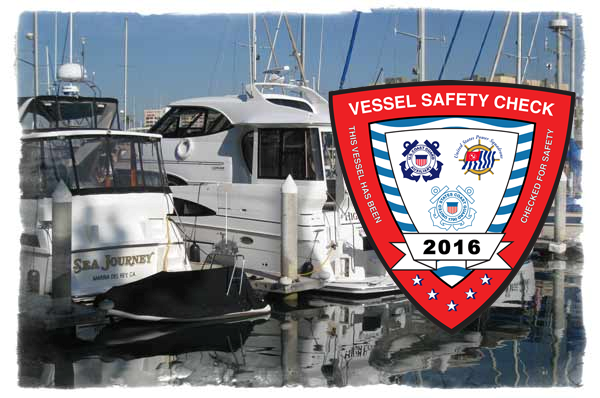
Your high performance marine parts experts know that vessels passing safety checks are awarded a U.S. Coast Guard / Auxiliary Decal that informs:


  • Coast Guard / Auxiliary

  • Harbor Patrol

  • Sheriff's & Police

  • other boating law-enforcement & safety agency's


that your boat was in full compliance with all Federal and State boating laws during a safety check for that year. Best of all every Vessel Safety Check is 100% Free of charge!


What if I Don't Pass?


Your marine supplies online analysts know that if your boat does not pass, no citation is issued at that time. Instead, you are provided a written report in how to correct any discrepancies.


Why Receive a Vessel Safety Check?


Safety! The peace of mind that your boat meets federal safety standards and that in an emergency you will have the necessary equipment to save lives and summon help.


Find an Examiner


Are you ready to get started with on your path to safer boating? Click the link below, then fill out the short request form and click the submit button. 


So don't forget these helpful reminders on why safety equipment checks are necessary. 1) Check the flares;  2) inspect fire extinguishers;  3) examine life jackets;  and 4) replace your batteries.


Stainless Marine has more information on marine performance parts, high performance marine parts, performance marine parts, and on the importance of safety equipment checks.


via 10 Boating Safety Equipment Checks


via Vessel Safety Checks


via Photo


Thursday, November 17, 2016

Marine Performance Parts Experts Help You to Strengthen Your Rode


Your Marine Performance Parts Specialists Offer You the Best Suggestions On Rode Strengthening


Stainless Marine your marine performance parts professionals would like to share with you these topics we thought would be of interest to you this month regarding how to strengthen your rode.


In the March 2016 article “Changing views on chain hooks,” we pointed out that the major manufacturers of marine anchor chains caution that some chain hooks can weaken chains under extreme loads. Your marine performance parts analysts know that these chain hooks are often used to attach an anchor snubber to the anchor chain. 


I would like to respond to the article in the March 2016 issue of Practical Sailor, 'Changing views on chain hooks,' which challenges a commonly accepted practice of using chain hooks to attach snubbers to the chain.


“The article claims that the Mantus chain hook reduced the breaking strength of the chain by 40 percent. The article suggests that any device promoted to attach a snubber to an anchor chain should not detract from the strength of the chain. 


As the April 2016 article pointed out, there exist cradling hooks designed for shortening chain that will not weaken chain. However, most stainless-steel hooks on the marine market are of a different design, which do impart some point loading. Made of stainless-steel and designed specifically for marine use, the Mantus hook is no different in that regard. However, the assertion that Mantus hook exacerbates the point loading was derived using an undersized ¼-inch hook with larger 5/16-chain.


I am concerned that some sailors may interpret your report to mean that chain hooks are potentially not safe to use for attaching a snubber line to chain. 


The American Boat and Yacht Council publishes standards used by manufacturers as guide to help design marine hardware.


The very reason to use a chain hook is to connect a snubber to the chain and dissipate these loads. This is quite different from using a chain hook for attaching two stretches of chains together or for shortening the chain as is done in the lifting industry. 


Shock loads are usually assumed to be three times the static loads. A recent article on snubbers published in the March 2016 issue of Practical Sailor explores this topic. 


Go to http://www.stainlessmarine.com/product-category/diesel-exhaust-risers-elbows/ and see how you can always find more information as well as get assistance on marine performance parts and on how to strengthen your rodes at Stainless Marine.


“The March 2016 issue, which focused on snubber loads, tabulated the loads for a 40-foot monohull boat in 60-knots with the following scenarios:


• Chain with no snubber (not elastic system, shock loads present) – 4,140 pounds


• ABYC worst case (assuming not elastic system, shock loads present) – 4,898 pounds


• Chain with a 30 foot ½ inch three strand nylon bridle (shock loads mitigated) -1,574 pounds (62 percent reduction in peak loads or about 1/3 of the ABYC worst case)


• 5/16 Grade 30 chain breaking strength – 7,600 pounds


“For reference, the Mantus hook designed for 5/16 chain has the working load limit of 1,877 and an ultimate breaking strength of 7,511 pounds.


To summarize these loads on the rode for a 40-foot boat in sustained 60 knots of wind:


• Maximum load predicted on the chain with a 30-foot bridle: 1,574 pounds


• Bridle working load limit (30-feet ½-inch three-strand nylon bridle): 1,874 pounds (overestimate, see above. Also assuming brand new line)


• Working load limit for a 5/16 Mantus chain hook: 1,877 pounds (ultimate breaking strength 7,511 pounds)


• Working load limit for 5/16 Grade 30 chain: 1,900 pounds (ultimate breaking strength 7,600 pounds)


“Ropes, however, can indeed fail due to age related ultra-violet degradation and chafe, and if the snubber fails loads on anchor chain may actually get to the ABYC predicted 4,898 pounds and certainly chain, the anchor, swivel and the deck hardware should be adequately sized to handle these loads.”


Visit us and see how Stainless Marine has more information regarding marine performance parts and on how to strengthen your rodes. 


via Can a Snubber Hook Weaken Your Rode?


Wednesday, November 16, 2016

Boat Engine Parts Analysts Show You How to Get Your Coffee Fix While Boating


Image result for instant coffee for sailing


Your Boat Engine Parts Experts Help You Figure Out How You'll Make Coffee On Your Boat


Stainless Marine your boat engine parts professionals would like to share with you these topics we thought would be of interest to you this month regarding how to get your coffee fix while boating.


Your boat engine part analysts know that there are a number of things to consider when deciding how you'll make coffee in your boat's galley. Your marine engine parts online experts feel that no one system is right for everyone.


The only method that I don't recommend is trying to use a 12 volt coffeemaker.  Everyone I've ever known who has tried one, and every review I've ever read, says that they take way too long to brew a pot of coffee.


Considerations in Making Boat Coffee


Before looking at the various possibilities for making coffee on a boat, let's first ask a few questions.  The answers to these will help determine which system is best for your situation.


How much coffee do you need to make at a time? A typical ceramic mug or insulated cup holds 12 to 16 ounces, while most coffee pots are labeled in 6-ounce cups (a few consider 4 ounces to be “one cup”).


Is electricity available and are you willing to use it for coffee? Your marine engine performance parts specialists understand that electric coffeemakers typically draw 800 watts (more on initial start up) and so won't run off the small inverters that you plug into a cigarette lighter.


Will you primarily be making coffee at a dock, at anchor or while underway? Some methods will make coffee in almost any conditions, while others are best only in calm waters.


Your Boat Engine Parts Specialists Feel That You Must Be Active In Making Your Coffee


You can find more information as well as get assistance on marine boat parts and on how to get your coffee fix while boating at Stainless Marine.


Do you want a hands-off operation or are you willing to be more active in making your coffee? Your marine boat parts Your marine boat parts professionals know that some methods require constant attention, others require timing, and others can be started and left.

How long are you going to want to keep your coffee hot? Will you have a cup or two in the morning and that's it, or will you want to have another cup hours later, perhaps in the middle of a watch?


No Electricity Needed:


  • Instant Coffee

  • Manual Drip Cone

  • French Press

  • Stovetop Percolator

  • Aeropress


One safety issue:  with any of the stovetop methods, you really need a gimbaled stove and pot restraints to boil water if the boat is moving at all – the dangers of a pot of boiling water tipping or sloshing are just too great.


Espresso drinker?  I'm not, but several readers are.  Check out the espresso makers they like.


The verdict? Your marine supplies New Orleans professionals know that they actually taste good. The cubes come in packs of four–two cubes equal one cup of coffee. I actually ate all four at once, as they have a sugary coating that makes them taste like coffee ice cream.


Nootrobox, the company that makes the cubes, says each cube has 50 mg of caffeine, and is supplemented with Vitamins B6 and B12, plus 100 mg of L-theanine–the active ingredient in green tea.


Stainless Marine has more information on boat engine parts, marine boat parts, boat parts online, and on how to get your coffee fix while boating.


via GoCube's Chewable Coffee


Thursday, November 10, 2016

Marine Engine Parts Experts Share the Proper Manners for Riding Winter Waters


Image result for winter water seamanship


Your Marine Engine Parts Specialists Fuel the Boating Passion Even In Winter


Stainless Marine your marine engine parts professionals would like to share with you these topics we thought would be of interest to you this month regarding the proper manners for riding winter waters. 


Your marine engine parts analysts know that the weather may have cooled, but the passion to continue boating burns bright for many. Once fall sets in for good, the skies get bluer, the air gets crisper, and the crowds get thinner. 


Wooly Bully


The adage “Dress for the water, not the weather” applies. Odd balmy days will spur boaters to cruise. But cold water behooves us to wear fabrics such as wool that retain heat, even when wet. 


Killer Tradition


The survival technique of floating in place while lowering one's head into the water will cause you to lose body heat and die faster. 


Captain Fantastic


Good skippers are ever mindful of crew comfort, and this is especially so in colder weather. A rejuvenating blast of spray that has everybody gleefully shrieking in July may cause a different reaction in October. 


Get Some Trim


During freezing temperatures, water below the surface stays warmer. For that reason, it's a good idea for owners of outboards to leave the engine trimmed down at the dock if air temps are expected to get frigid. 


Morning Don't


Frost is often invisible, especially when it forms on white boats. Frost also renders even the most aggressive nonskid surface useless. 


Snow Job


Your boat may have a self-bailing cockpit, but, unfortunately, snow won't flow out of the scuppers. Prepare to shovel out your water-stored boat if the white stuff falls


Go to http://www.stainlessmarine.com/ and see how you can find more information as well as get assistance on marine engine parts and on the proper manners for riding winter waters at Stainless Marine.


In fact, even if it rains go check the boat; an overnight freeze can block drains with frozen water, even if water elsewhere has returned to a liquid state.


Snow Tow


Snowmobilers, hunters, and landscapers moving snowblowers to job sites are among the myriad people who pull loaded trailers on snowy, icy roads. 


That bit of advice is as good on the road as it is on the water. Stay safe.


Quick Tip: Winterize your head and buy a portable head for cold-weather boating.


Many sailors make the most of reduced rates and learn to sail or do their Yachtmaster exams in the winter, when the sailing schools take advantage of empty cruising grounds and long nights to school their students in the arts of navigation and night sailing.


Keep your tanks topped off


It's worth filling up with fuel and water as often as you can in the winter: fuel berth opening hours are likely to be reduced, and hoses may freeze or the water supplies may be turned off to protect the pipes – which makes it tricky to refill your tanks!


Engine


For boats left afloat in salt water, it's unlikely that the temperatures will dip low enough to cause any water left in the engine to freeze, but it's worth attending to if a particularly cold snap is forecast. 


Bedding


If you're keeping your bedding on board so you can make a quick getaway, consider storing it in a vacuum bag. These keep linen and duvets dry and mildew-free: the air can be sucked out with a 12V vacuum cleaner if you're not on shore power.


Learn more at Stainless Marine and see how we always have more information on marine engine parts and on proper manners for riding winter waters.


via Cold-Weather Seamanship


via Photo


via 26 Tips for Winter Sailing